MugsArtStore
The Great Race to Promontory Coffee Mug: Celebrating 150 Years of the Transcontinental Railroad
The Great Race to Promontory Coffee Mug: Celebrating 150 Years of the Transcontinental Railroad
Couldn't load pickup availability
Few moments in American railroad history carry the same meaning as the meeting of the Union Pacific and Central Pacific railroads at Promontory Summit, Utah.
On May 10, 1869, two steam locomotives faced one another across a newly completed section of track while railroad officials, workers, photographers, soldiers, musicians, and spectators gathered for the ceremonial driving of the Golden Spike. That day marked the completion of the first transcontinental railroad and created a continuous rail connection across the United States.
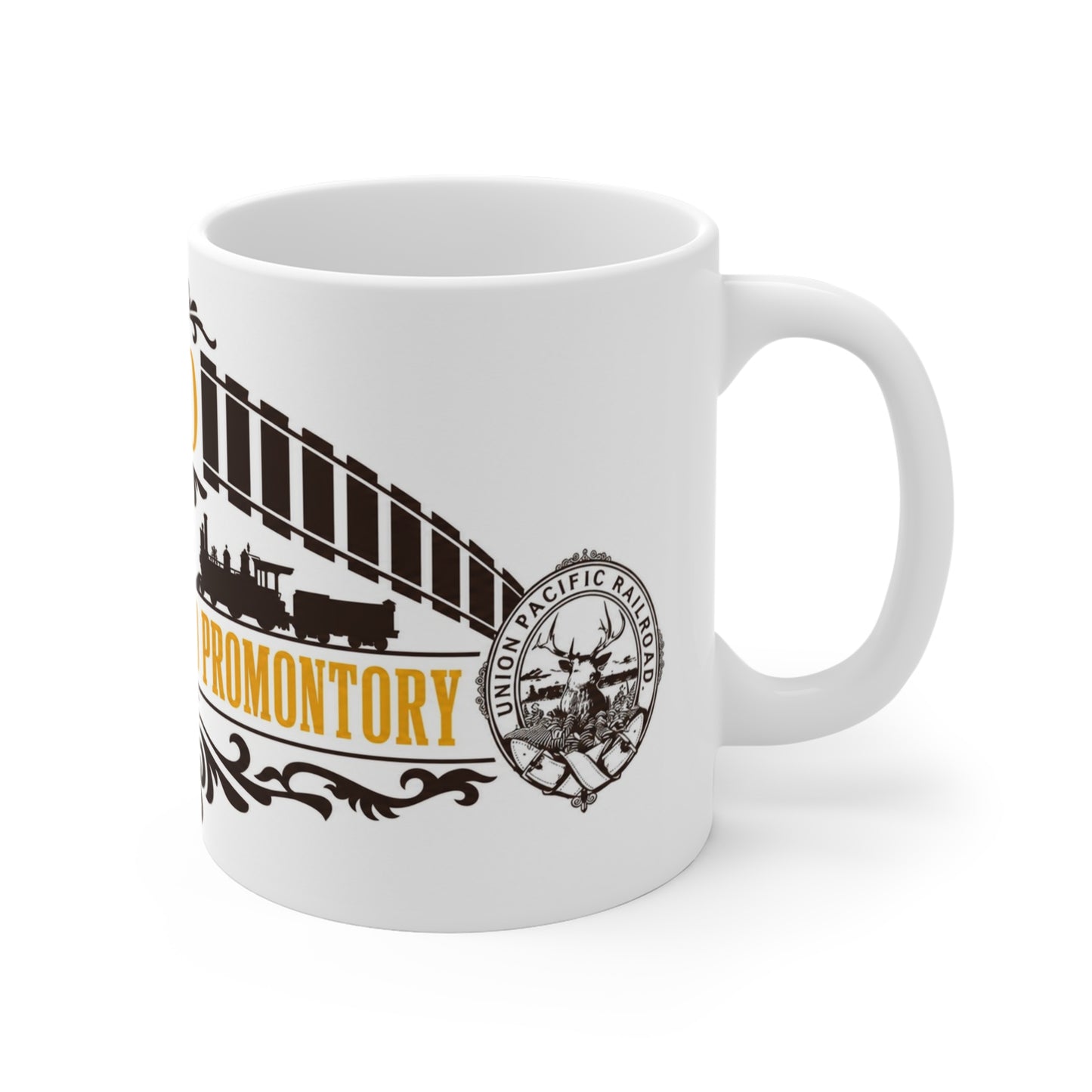
The Great Race to Promontory 150th Anniversary Coffee Mug celebrates that historic achievement through bold black-and-gold railroad artwork. Its design features the number 150, sweeping railroad tracks, opposing steam-locomotive silhouettes, a Union Pacific shield, vintage-style Central Pacific and Union Pacific emblems, and the words:
THE GREAT RACE TO PROMONTORY
Ornamental flourishes give the artwork the appearance of a commemorative railroad poster, anniversary emblem, or historic railway advertisement.
For railroad enthusiasts, Golden Spike history collectors, steam-locomotive fans, model railroad hobbyists, Union Pacific supporters, Central Pacific historians, and anyone fascinated by the building of the American West, this mug offers a meaningful way to remember one of the most influential transportation events of the nineteenth century.
Explore this design and more distinctive railroad coffee mugs at https://mugsartstore.com.
A Railroad Dream Becomes a National Project
For decades, Americans discussed building a railroad that could connect the eastern states with California and the Pacific Coast. The distances were enormous, the terrain was difficult, and the financial risks were significant.
The Pacific Railway Act of 1862 provided federal support for the project and helped establish the Union Pacific Railroad. Union Pacific would build westward, while the Central Pacific Railroad constructed the western section eastward from Sacramento, California. The two lines eventually joined at Promontory Summit.
The project was not simply another railroad extension.
It required workers to cross plains, deserts, rivers, mountain ranges, canyons, and isolated territory. Crews had to survey routes, level land, blast tunnels, construct bridges, lay ties, place rails, establish camps, and transport supplies across regions that often had few roads or nearby communities.
Every completed mile represented human effort, financial pressure, engineering judgment, and a race for progress.
Union Pacific Builds West
Union Pacific construction moved westward from the Missouri River region across Nebraska and Wyoming toward Utah.
Much of the landscape appeared open, but railroad builders still faced major obstacles. Rivers required bridges. Hills demanded cuts and fills. Supplies had to be delivered to moving construction camps. Workers faced extreme heat, freezing winters, severe storms, limited shelter, accidents, illness, and isolation.
The railroad’s crews included many Irish immigrants, Civil War veterans, formerly enslaved African Americans, and workers from numerous other backgrounds. Their labor pushed the tracks mile after mile across the Great Plains and through the mountain West.
As the rails moved forward, temporary camps sometimes became permanent settlements. Towns developed around depots, water stops, repair facilities, freight yards, and places where passengers and supplies could be transferred.
The railroad was not merely crossing the West—it was reshaping it.
Central Pacific Builds East
Central Pacific faced some of the most difficult construction conditions on the entire route.
Starting in Sacramento, crews moved east toward the Sierra Nevada Mountains. Building through the Sierra required deep cuts, towering fills, bridges, snow sheds, and tunnels blasted through hard rock.
Chinese immigrants formed the majority of the Central Pacific workforce. Thousands performed dangerous and physically demanding labor through the mountains and later across Nevada and Utah. The National Park Service estimates that approximately 10,000 to 20,000 Chinese immigrants were recruited for the Central Pacific portion of the project.
Their contribution was essential.
Workers drilled into rock, placed explosives, removed debris, shaped grades, constructed retaining structures, and continued through severe winter weather. Their skill, endurance, and sacrifice helped make the transcontinental railroad possible, although their role was often minimized in popular accounts and anniversary photographs.
A complete telling of the Great Race to Promontory must recognize the workers behind the rails—not only the executives whose names appeared in newspapers.
A Race Toward Utah
As Union Pacific approached from the east and Central Pacific advanced from the west, the construction effort became intensely competitive.
Federal incentives rewarded completed track, encouraging both companies to build rapidly. In Utah, the railroads even graded overlapping and parallel routes while officials debated where the final connection would be made.
Promontory Summit was eventually selected as the meeting point.
The term “Great Race to Promontory” captures the speed, competition, determination, and national attention surrounding the final stage of construction. More than a century later, Union Pacific used the name for its 150th-anniversary programs, exhibits, community events, and steam celebrations leading up to May 2019.
The coffee mug’s curving railroad tracks and opposing locomotive silhouettes visually represent those two construction efforts moving toward the same historic destination.
May 10, 1869: The Wedding of the Rails
On May 10, 1869, a crowd gathered at Promontory Summit in Utah Territory.
Central Pacific and Union Pacific officials prepared a polished ceremonial tie, precious-metal spikes, and specially selected tools. Telegraph wires were connected so that people across the country could receive updates as the final ceremony unfolded.
At 12:47 p.m., the message “D-O-N-E” was transmitted across the nation, announcing that the railroad had been joined. What previously required months of difficult overland or sea travel could now be accomplished by rail in days.
The ceremony became known as the Wedding of the Rails.
The image of two locomotives facing one another while railroad workers and officials gathered between them became one of the most famous scenes in American transportation history.
The moment represented connection, speed, commerce, communication, engineering, and national ambition. It also marked the beginning of enormous changes for communities, industries, landscapes, and Indigenous nations throughout the West.
Jupiter and Union Pacific No. 119
The two locomotives associated with the Golden Spike ceremony were the Central Pacific’s Jupiter and Union Pacific’s No. 119.
Neither engine had originally been selected for the honor.
Jupiter took the place of another Central Pacific locomotive after the originally assigned engine was damaged during the journey. Union Pacific No. 119 was called into service after flooding and bridge damage prevented the original locomotive from reaching Promontory. Through unexpected circumstances, both became permanent symbols of the transcontinental railroad.
Jupiter carried Central Pacific President Leland Stanford’s special train to the ceremony. Union Pacific No. 119 brought Vice President Thomas Durant and his party from the east.
The original locomotives continued in service after 1869 and were eventually scrapped. Historically accurate working replicas were completed and placed into service at Promontory in 1979, where they continue to represent the two engines that met during the Golden Spike ceremony.
The steam-engine silhouettes on this mug evoke that unforgettable meeting: one railroad arriving from the east and the other from the west.
The Meaning of the Golden Spike
The famous spike was ceremonial rather than an ordinary piece of track hardware.
It was placed into a polished laurel tie during the ceremony and came to symbolize the connection between the Central Pacific and Union Pacific lines.
The event’s photographs, newspaper reports, telegrams, and surviving artifacts transformed the Golden Spike into one of America’s most recognized transportation symbols.
The spike represented more than the completion of a construction project.
It represented the belief that technology could overcome distance. It promised faster movement of passengers, mail, freight, machinery, agricultural products, and information. It also encouraged new investment, settlement, tourism, industrial expansion, and commercial development across the West.
The mug’s large gold 150 reflects the anniversary of this historic achievement, while the railroad tracks passing through the design symbolize the continuous route that connected distant regions.
The Workers Behind the Achievement
The Golden Spike ceremony focused heavily on railroad executives and government officials, but the line was built by tens of thousands of laborers.
Chinese and Irish immigrants made up the largest portions of the workforce. They were joined by African American workers, Civil War veterans, Latter-day Saint laborers from Utah communities, German and other European immigrants, and many workers whose names were never preserved in official records.
Their work was exhausting and dangerous.
They handled explosives, moved rock and earth, installed ties and rails, built bridges, maintained tools, cared for animals, transported supplies, prepared food, repaired equipment, and followed the construction camps as the railhead moved forward.
Some workers died in explosions, avalanches, accidents, harsh weather, and outbreaks of illness. Many faced discrimination, unequal pay, dangerous assignments, and limited recognition.
A meaningful commemoration of the transcontinental railroad honors not only the executives and locomotives, but also the workers whose strength and skill turned the project into reality.
A Transformative but Complicated Legacy
The completion of the railroad dramatically expanded travel, trade, settlement, and communication. It also brought serious consequences for Indigenous nations whose homelands were crossed by the new rail routes.
The National Park Service notes that the railroad crossed the homelands of at least 15 Tribal Nations. Increased settlement placed new pressure on land, water, wildlife, hunting grounds, and traditional cultural practices. Railroad access also contributed to commercial bison hunting and the rapid decline of herds that were central to the lives of many Plains peoples.
Recognizing these consequences does not diminish the railroad’s engineering importance. It provides a fuller and more honest understanding of how dramatically the project changed the West.
The transcontinental railroad can be remembered as an extraordinary transportation achievement while also acknowledging the workers who were overlooked and the Indigenous communities whose lives and lands were profoundly affected.
History becomes more meaningful when every part of the story is included.
The 150th Anniversary Celebration
The number 150 displayed prominently on this mug refers to the 150th anniversary of the Golden Spike ceremony, celebrated in 2019.
Union Pacific organized a series of community presentations, historical exhibitions, educational programs, commemorative-spike ceremonies, and steam events along the original transcontinental route. The events culminated near May 10, 2019, exactly 150 years after the completion ceremony.
Thousands gathered at Golden Spike National Historical Park for the anniversary. Union Pacific also celebrated through heritage-steam operations connected with Big Boy No. 4014 and steam locomotive No. 844, bringing railroad history to communities along the route.
The phrase “Great Race to Promontory” became an especially fitting title for the commemoration.
It connected the modern celebration with the nineteenth-century construction race, the two railroad companies, the workers, the famous locomotives, and the moment when east met west.
A Commemorative Railroad Design
The mug’s artwork brings together several visual elements connected with the historic event.
The large golden 150 immediately establishes the anniversary theme. Curving tracks extend outward from the number, representing the Central Pacific and Union Pacific routes.
Beneath the tracks, two steam locomotives move toward the center.
The Union Pacific shield appears between them, while the sides of the wraparound design feature vintage-style emblems representing both Union Pacific and Central Pacific.
The gold, dark brown, and white color palette creates a classic commemorative appearance. Decorative flourishes frame the artwork and give it the feeling of a historic certificate, railroad broadside, anniversary poster, or nineteenth-century advertisement.
Because the artwork continues around the mug, different details become visible as it is turned.
For Railroad Historians and Railfans
This Great Race to Promontory mug is designed for people who appreciate the stories behind the locomotives.
It can become part of a collection focused on the Golden Spike, Union Pacific, Central Pacific, the first transcontinental railroad, Jupiter, No. 119, steam-locomotive history, Western expansion, Utah history, or historic railway advertising.
Display it alongside railroad books, vintage maps, Golden Spike photographs, model trains, commemorative coins, route timetables, lanterns, railroad signs, or other transportation memorabilia.
The design offers enough historical detail to attract serious collectors while remaining bold and attractive for everyday use.
A Meaningful Railroad Gift
This commemorative mug is a thoughtful choice for railroad employees, retired railroaders, train enthusiasts, steam-locomotive fans, model railroad builders, transportation historians, museum visitors, Union Pacific collectors, Central Pacific researchers, and anyone fascinated by the Golden Spike story.
It can be given for a birthday, retirement, Father’s Day, Christmas, railroad anniversary, train-club meeting, historical presentation, or visit to Promontory Summit.
Pair it with a transcontinental-railroad history book, Golden Spike photograph, railroad map, specialty coffee, or model locomotive to create a memorable railway-themed collection.
Bring Railroad History to Every Coffee Break
A coffee mug can become a small, everyday connection to history.
Each time this design is used, it recalls the race across the continent, the workers who built the line, the locomotives that met at Promontory, and the message that traveled across the telegraph wire:
D-O-N-E.
It remembers the excitement of May 10, 1869, while acknowledging the complicated changes that followed.
Most importantly, it keeps the story moving forward so new generations can continue learning about the people, engineering, challenges, and consequences behind the first transcontinental railroad.
Discover More Railroad Mugs at MugsArtStore.com
At MugsArtStore.com, railroad enthusiasts can explore coffee mugs inspired by historic steam locomotives, legendary railway companies, famous routes, heritage trains, passenger service, logging railroads, Western transportation, and classic railroad artwork.
The Great Race to Promontory 150th Anniversary Coffee Mug is a distinctive choice for anyone who values Golden Spike history and the unforgettable moment when the Union Pacific and Central Pacific railroads met.
Explore the collection at:
Pour the coffee.
Remember the workers.
Celebrate the locomotives.
Honor the history.
And keep the Great Race to Promontory alive—one cup at a time.
#GoldenSpike #TranscontinentalRailroad #PromontorySummit #GreatRaceToPromontory #UnionPacific #CentralPacific #RailroadHistory #SteamLocomotive #Railfan #TrainLovers #ModelRailroad #TrainCollector #RailroadMug #RailroadHeritage #MugsArtStore
Share